Palming Techniques In Magic: The Art of Hiding In Plain Site

One of the most valuable skills a magician can develop is the ability to secretly conceal an object while making the hand appear completely natural. This fundamental principle of sleight of hand is known aA playing card, coin, ball, poker chip, or other small object can seemingly disappear while actually remaining hidden in the magician's hand. The technique sounds simple, but convincing palming requires much more than merely hiding something.
The real secret is naturalness.
A perfectly concealed card means little if the magician's hand suddenly becomes stiff, awkward, or suspicious. Successful palming combines concealment, timing, misdirection, movement, and audience psychology.
What Is Palming?
Palming is the secret retention of an object in or around the hand while creating the impression that the hand is empty.
Contrary to the name, the object does not always have to be literally held against the palm. Magicians have developed numerous concealment positions involving the fingers, thumb, edges of the hand, and backs of the fingers.
Different palms serve different purposes.
Some are designed for maximum security. Others allow greater freedom of movement. Some are particularly useful for vanishes, while others make productions, switches, steals, or secret transfers possible.
The best palm is therefore not necessarily the most difficult or most deceptive technique. It is the palm that best serves the effect being performed.
Card Palming
Playing cards present an unusual challenge. Their large, flat shape makes them considerably more difficult to conceal naturally than many smaller objects.
Nevertheless, generations of card magicians have developed ingenious methods for doing exactly that.
Classic or Full Palm
The Classic Palm, sometimes called the Full Palm, places the card against the palm where slight pressure keeps it securely concealed.
The hand remains gently curved rather than tightly closed.
One of the most common mistakes beginners make is gripping too strongly. This causes the fingers and hand to become rigid.
The objective should be:
Secure card. Relaxed hand. Natural movement.
The audience should never suspect that the hand is holding anything.
Top Palm
The Top Palm secretly transfers one or more cards from the top of the deck into the magician's hand.
It is extremely useful because the action can occur while apparently performing an ordinary movement with the deck.
Once palmed, the card can be secretly transferred elsewhere, produced from another location, switched for another card, or used to accomplish a seemingly impossible revelation.
There are also sophisticated one-handed top palms, allowing the magician to obtain the card with minimal assistance from the opposite hand.
Bottom Palm
The Bottom Palm accomplishes a similar objective with a card on the bottom of the deck.
Bottom palming becomes particularly useful when the construction of an effect naturally places the desired card at the bottom.
As with most advanced sleight of hand, the secret movement should be motivated by something the audience understands—squaring the deck, placing it down, handing it to someone, or performing another natural action.
Gambler's Cop
The Gambler's Cop is one of the most practical card concealments.
Instead of placing the card completely against the center of the palm, the card is held lower in the hand, usually near the base of the fingers.
The position can be especially effective when the hand naturally hangs at the magician's side.
Because the card doesn't necessarily need to travel as deeply into the hand as with a conventional palm, the Gambler's Cop can also provide an efficient way of secretly removing a card from the deck.
Tenkai Palm
The Tenkai Palm conceals a card along the side of the hand.
From favorable viewing angles, the hand can appear surprisingly open.
The technique is particularly useful for productions, vanishes, transformations, and visual close-up magic.
Its effectiveness also demonstrates an important principle of sleight of hand:
A magician doesn't always need to hide an object behind the largest part of the hand. Sometimes the viewing angle provides the concealment.
Diagonal Palm Shift
The Diagonal Palm Shift is a sophisticated method of secretly moving a card from within the deck directly into palm.
It combines control and concealment into one operation.
Rather than first controlling a selected card to the top or bottom and then palming it, the magician can secretly remove the card from the interior of the deck.
It is an advanced technique, but an extremely valuable one for serious card workers.
Coin Palming
Coins are particularly well suited to palming because their small size allows them to disappear into several natural positions within the hand.
Mastering several different coin palms gives the magician the ability to apparently make coins vanish, appear, multiply, travel, or transform.
Classic Coin Palm
The Classic Palm is perhaps the most famous coin concealment.
A coin is retained in the palm through controlled muscular pressure rather than being visibly gripped by the fingers.
When performed correctly, the fingers remain relatively free.
That freedom allows the magician to gesture or perform other actions while secretly retaining the coin.
Learning the Classic Palm can initially feel awkward because the muscles of the hand must develop enough control to retain the coin without excessive tension.
Practice eventually turns that tension into a much more natural position.
Finger Palm
The Finger Palm is one of the most useful techniques for beginning coin magicians.
The coin rests near the bases of the curled fingers.
Because this position resembles the natural shape of a relaxed hand, it can provide excellent concealment without requiring the muscular control of a Classic Palm.
Finger Palm is particularly useful for vanishes, transfers, productions, and routines involving multiple coins.
Thumb Palm
In a Thumb Palm, the coin is secretly retained near the base of the thumb.
The position provides another useful alternative when the magician needs to move between different concealments.
Transitions between palms are extremely important because remaining in one position throughout an entire routine can restrict movement.
Downs Palm
Named for magician T. Nelson Downs, the Downs Palm is an important technique in classical coin manipulation.
The coin is concealed near the thumb in a manner that can allow the fingers to appear remarkably free.
Downs became famous for his extraordinary coin manipulation, and techniques associated with his work remain influential in coin magic.
Edge Palm
An Edge Palm holds the coin on its edge rather than flat against the hand.
Several variations of edge palming exist.
These positions can provide excellent concealment while allowing the magician to transition between other grips and palms.
Finger and Back Clips
Coins can also be secretly clipped between the fingers.
Depending upon the exact position, these techniques allow the coin to remain concealed while portions of the hand appear empty.
Back clips and related techniques place the coin behind the fingers, opening possibilities for extremely visual productions and vanishes.
Palming Other Objects
The principles of palming extend far beyond playing cards and coins.
Magicians have developed concealments for sponge balls, billiard balls, poker chips, dice, thimbles, small silks, tokens, rings, and many other close-up props.
The exact mechanics change according to the object's size and shape, but the underlying principles remain remarkably similar.
The Real Secret: Naturalness
The technical method of holding an object is only the beginning.
A magician can execute the most sophisticated palm perfectly and still expose the secret simply by behaving unnaturally.
Imagine someone sitting at a table with both hands relaxed. Now imagine that person suddenly stiffening one hand, spreading the fingers unnaturally, and refusing to move it.
Even if nothing can actually be seen, attention is immediately drawn toward that hand.
This leads to one of the most important lessons in sleight of hand:
Don't merely conceal the object. Conceal the fact that you are concealing something.
The palming hand should behave as much as possible like an ordinary hand.
Timing and Misdirection
Palming is strongest when the audience isn't concentrating on the moment the secret action occurs.
This does not necessarily require dramatic misdirection.
Something as simple as making eye contact, asking a spectator a question, moving another object, or directing attention toward an important part of the presentation can shift the audience's focus.
Good magic creates moments of importance and moments of relaxation.
Secret actions frequently occur during those moments of relaxation.
The audience remembers the important events while overlooking movements that seemed insignificant.
Beginner Safety and Practice Guidelines
Palming is generally a low-risk skill, but beginners should develop good practice habits from the beginning. Sleight of hand depends on relaxed, controlled movement—not force.
Never Force the Position
A palm should not hurt.
When learning a new position, it is tempting to squeeze the card or coin tightly because you are afraid of dropping it. Excessive pressure makes the hand look unnatural and can quickly cause fatigue.
If you experience pain, numbness, tingling, cramping, or unusual discomfort, stop practicing and give your hand a rest. Do not try to force your fingers, thumb, or wrist into an uncomfortable position.
Some awkwardness is normal when learning unfamiliar movements. Pain is not a requirement for mastering sleight of hand.
Start With Short Sessions
Beginners do not need hour-long practice sessions.
Start with approximately five to ten minutes of focused practice. Take breaks and gradually increase your practice time as the movements become comfortable.
Short, attentive sessions are usually more productive than repeatedly performing a technique after your hand has become tired.
Use Safe Practice Objects
Begin with ordinary playing cards, lightweight poker chips, sponge balls, or smooth coins and tokens.
Avoid sharp, damaged, extremely heavy, or otherwise hazardous objects while learning. A beginner should concentrate on developing coordination rather than worrying about an object causing injury if it slips or falls.
Practice over a table, carpet, close-up mat, or another forgiving surface when learning coin techniques. You will drop things—and that is perfectly normal.
Learn the Position Before the Secret Move
Do not immediately try to perform the entire sleight at full speed.
First learn where the object belongs.
Place the card or coin manually into the correct palm position. Hold it briefly. Relax. Remove it.
Repeat.
Once the position becomes comfortable, begin practicing the secret transfer into that position.
This separates two different skills: holding the object naturally and getting the object there secretly.
Slow Down
Speed does not automatically make sleight of hand deceptive.
In fact, rushing frequently makes a magician look suspicious.
Practice slowly enough that you can observe exactly what your fingers are doing. Accuracy and relaxation should come first. Speed will develop naturally through repetition.
Practice Both the Secret and the Natural Action
If your right hand contains a palmed coin, compare it with your empty left hand.
How do the fingers naturally curve?
Where does the thumb rest?
How does the hand move when you gesture?
Your empty hand can become your best teacher.
Rather than forcing the palming hand into what you think looks natural, study what your genuinely relaxed hand already does.
Use a Mirror—Then Use Video
A mirror is useful for checking whether corners or edges are visible, but it can encourage you to stare constantly at your own hands.
Video provides another perspective.
Record yourself performing the move, put the cards or coins down, and watch the recording as though you were a spectator.
Look for stiffness, unnecessary finger movement, suspicious pauses, flashing edges, or moments when one hand behaves differently from the other.
Practice Your Angles
A concealment that looks perfect from directly in front may be completely exposed from the side.
Practice while viewing the hand from the front, left side, right side, slightly above, and slightly below.
Learning where a technique can and cannot safely be viewed is part of mastering it.
Don't Practice Secret Moves in Risky Situations
Practice while seated or standing somewhere safe and stable.
Do not practice manipulations while driving, walking near traffic, handling hot objects, using machinery, or doing anything else that requires your full attention.
Sleight of hand can wait.
Don't Become Discouraged by Dropping Things
Every magician drops cards and coins while learning.
Dropping an object does not mean you lack the ability to perform the technique. It usually means you are developing the fine balance between holding something securely and holding it naturally.
Rather than immediately squeezing harder, reset the object and try again with slightly different positioning.
A Simple Beginner Practice Routine
A useful daily exercise can be completed in about 10 minutes.
Spend the first two minutes simply placing the object into palm and relaxing the hand. Spend the next two minutes holding the palm while gently moving your fingers. Then spend two minutes practicing natural gestures, two minutes checking different viewing angles, and the final two minutes practicing the complete move and release.
Do not worry about performing quickly.
The goal is control without tension.
Practice Palming Correctly
Beginners often practice only the mechanical concealment. A better approach is to practice the entire behavior surrounding it.
Place an object into palm and then perform ordinary activities.
Walk across the room. Gesture naturally. Pick something up. Turn your body. Talk while moving your hands.
Then ask a simple question:
Does the hand carrying the concealed object behave differently from the empty hand?
If it does, continue working until the difference disappears.
Quality is more important than endurance. Thirty seconds of relaxed palming is better than five minutes of gripping an object so tightly that the hand becomes visibly tense.
Don't Try to Learn Every Palm
Beginning magicians sometimes make the mistake of collecting techniques instead of mastering them.
Knowing twenty palms poorly is far less useful than performing three palms convincingly.
For cards, a strong foundation might begin with the Classic Palm, Gambler's Cop, and Top Palm before progressing into techniques such as the Tenkai Palm and Diagonal Palm Shift.
For coins, begin with the Finger Palm, Classic Palm, and Thumb Palm before exploring Downs Palm, Edge Palm, clips, and more specialized concealments.
Each technique should eventually become something you can perform without consciously thinking about the mechanics.
Palming Is a Tool, Not the Trick
Perhaps the most important lesson is that palming itself is rarely the magic.
The audience should not be thinking:
"He must have hidden the card in his hand."
They should remember something impossible.
The signed card vanished from the deck and appeared inside an envelope.
The coin disappeared and materialized somewhere impossible.
An apparently empty hand reached into the air and produced a playing card.
Palming is simply one of the invisible tools that makes those impossible moments possible.
Final Thoughts
Palming represents sleight of hand in its purest form.
The magician secretly possesses something while apparently possessing nothing.
Learning the physical technique requires patience. Learning to make that technique invisible requires considerably more.
Study your angles. Reduce unnecessary tension. Practice natural movement. Understand where your audience is looking. Most importantly, remember that technical perfection serves a larger purpose.
The goal is not to demonstrate how cleverly you can hide an object.
The goal is to create a moment in which the audience believes there was never anything in your hand at all.

Classic / Full Palm — Playing Card
Start with the card flat in your hand.
Place a single playing card across your palm, roughly centered from the base of your fingers toward the heel of your hand.
Position the outer corners.
The card should contact your hand near the base of the thumb on one side and near the base of the little finger on the other.
Apply gentle pressure.
Very slightly contract the muscles of your palm so the card bows just enough to stay in place. You do not want to visibly squeeze the card.
Release your fingers.
Let your fingers relax naturally. The card should remain hidden against the palm without being gripped by the fingertips.
Keep the hand curved.
A completely flat hand looks unnatural and may expose the card. Maintain a soft, relaxed curve, as if your hand were simply resting.
Check your angles.
Look at your hand from the front, sides, and slightly below. Make sure no card corners are protruding beyond the edges of your hand.
Practice holding it while moving.
Walk around, gesture, pick up a small object, or move your other hand while keeping the palmed card secure. The goal is to make the hand look completely ordinary.
Practice the release.
To produce the card, relax the palm pressure and let the card slide toward the fingers, where you can grasp it and reveal it naturally.
Important tips:
Use light pressure, not force. If your hand looks stiff, the palm will become obvious. The secret is making the hand appear relaxed even though the card is concealed.
A good practice drill is to hold the card in Classic Palm for 30 seconds at a time, then gradually work up to several minutes while casually moving your hand.
THE MAGIC GUILD
Knowledge Illumines Possibilities
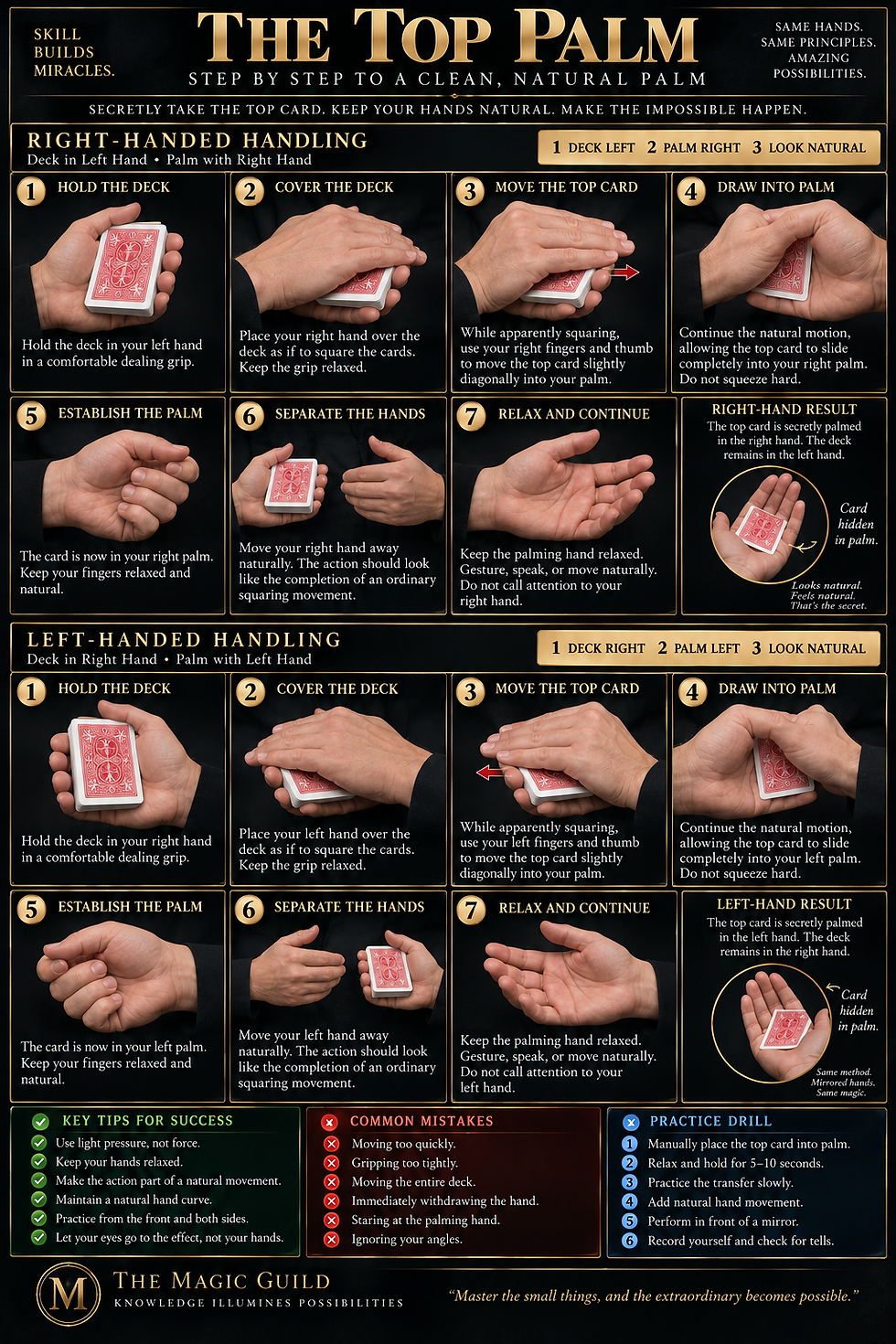
Top Palm - Playing Card:
The Top Palm is a fundamental card sleight that secretly transfers the top card of the deck into the magician's hand. Once the card has been palmed, it can be secretly removed from the deck, transported to another location, switched, or later reproduced.
The secret to a convincing Top Palm is not speed. It is making the secret action occur during an ordinary, motivated movement.
Step 1 — Hold the Deck
Hold the deck in your left hand in normal dealing grip if you are right-handed.
The deck rests across the left palm and fingers. Keep your grip comfortable and relaxed.
Your right hand approaches the deck naturally from above, as though you are simply going to square the cards.
Step 2 — Cover the Deck
Place the right hand over the deck.
The fingers should naturally extend around the outer end of the cards while the right thumb rests near the inner end.
Do not tightly grasp the deck.
The position should resemble an ordinary squaring action.
Step 3 — Contact the Top Card
As the hands apparently square the deck, establish contact with the top card.
The objective is to move only that card while the remainder of the deck stays reasonably square.
Keep the movement small.
At this stage, concentrate on control rather than speed.
Step 4 — Angle the Top Card
Use the fingers and thumb to cause the top card to move slightly diagonally away from the deck.
Only a small displacement is necessary.
The card begins moving into the area beneath the right palm.
Your right hand provides visual cover for this movement.
Step 5 — Draw the Card Into the Palm
Continue the natural squaring action as the top card moves farther beneath the right hand.
Allow the card to settle against the palm.
Do not squeeze the card tightly.
The card should be retained using the minimum amount of pressure necessary to keep it secure.
Step 6 — Establish the Palm
Once the card is completely clear of the deck, gently secure it in the right hand.
The card should lie diagonally or naturally across the palm according to your hand size and preferred palming position.
Relax the fingers.
This is one of the most important moments in the technique.
If the fingers suddenly become rigid when the card enters palm, spectators may sense that something has happened even though they cannot see the card.
Step 7 — Separate the Hands
Move the right hand away naturally.
Do not immediately pull it away from the deck as though you are trying to hide something.
Instead, give the movement a reason.
For example, the right hand might move toward another object while the left hand places the deck onto the table.
The audience should perceive nothing more than the completion of an ordinary action.
Step 8 — Keep the Palming Hand Natural
Once the card is palmed, forget about it as much as possible.
Allow the right hand to assume its normal relaxed shape.
Avoid:
Clenching the fingers.
Holding the hand completely flat.
Pressing the thumb tightly against the hand.
Keeping the hand unnaturally motionless.
Staring at the palming hand.
The card is secret.
Your behavior should communicate that there is nothing important happening in that hand.
The Most Important Principle
A beginner often thinks:
"How quickly can I get the card into my palm?"
A better question is:
"When can I palm the card so nobody cares about my right hand?"
Timing is more important than speed.
The Top Palm becomes much stronger when performed during a natural action such as squaring the deck, turning toward the table, addressing a spectator, or preparing for the next phase of an effect.
Beginner Practice Drill
Start without trying to deceive anyone.
Place the top card manually into the correct palm position. Relax your hand and learn what the finished position feels like.
Next, practice the transfer slowly.
Square → move the card → establish the palm → relax → separate the hands.
Perform the sequence slowly about 10 times.
Then stop and rest your hand.
Once the mechanics become comfortable, practice the same action while looking forward rather than staring at your hands.
Finally, record yourself from the spectator's viewpoint.
If you can identify exactly when the card enters your palm, work on making the surrounding movements smoother rather than simply trying to perform the secret action faster.
Common Beginner Mistakes
Moving too quickly: Speed can make the action appear suspicious. Smoothness is more valuable.
Gripping too tightly: Excessive pressure makes the hand rigid.
Moving the entire deck: The top card should move independently while the deck remains controlled.
Immediately withdrawing the hand: A sudden retreat can advertise the secret action.
Watching the palming hand: Your eyes can direct the audience's attention toward the very thing you want them to ignore.
Ignoring angles: Practice from the front and both sides to discover where the card may become visible.
Safety and Comfort
Card palming should not hurt.
If you experience pain, cramping, numbness, or tingling, stop and rest your hand. Do not force your fingers into an uncomfortable position.
Different hand sizes may require slightly different card positions.
The objective is not to make your hand conform perfectly to someone else's technique. The objective is to understand the principle and find a comfortable position that provides secure concealment and natural movement.
Practice Standard
Practice the Top Palm until these three actions appear to be one continuous, ordinary movement:
Square the deck.Palm the card.Move naturally.
When the mechanics disappear into an innocent action, the Top Palm stops looking like a sleight.
That is when it begins to look like magic.
THE MAGIC GUILD
Knowledge Illumines Possibilities
Top Palm: Right-Handed and Left-Handed Handling
In card magic, instructions are traditionally written from a right-handed magician's perspective. This does not necessarily mean that the right hand performs every important action.
In fact, in many standard card techniques, a right-handed magician holds the deck primarily in the left hand, leaving the dominant right hand free to manipulate cards.
A left-handed magician can usually perform the same technique by simply reversing the hands.
Right-Handed Handling
For a typical right-handed magician:
Left hand = deck handRight hand = working or palming hand
The deck normally rests in the left hand in dealing grip.
The right hand performs actions such as taking cards, cutting the deck, squaring the cards, manipulating individual cards, and—depending on the technique—palming a card.
For example, when learning a standard Top Palm, a right-handed magician generally begins with the deck in the left hand.
The right hand comes over the deck as though squaring it.
During this action, the top card is secretly transferred into the right palm.
The result is:
Deck remains in the left hand → Top card ends in the right hand.
Left-Handed Handling
For a typical left-handed magician, the procedure can simply be mirrored:
Right hand = deck handLeft hand = working or palming hand
The deck rests in the right hand in dealing grip.
The left hand approaches from above and performs the working action.
During a mirrored Top Palm, the top card is therefore transferred into the left palm.
The result becomes:
Deck remains in the right hand → Top card ends in the left hand.
Side-by-Side Reference
Action | Right-Handed | Left-Handed |
Hold the deck | Left hand | Right hand |
Dealing grip | Left hand | Right hand |
Working hand | Right hand | Left hand |
Hand approaches deck | Right | Left |
Top card moves toward | Right palm | Left palm |
Palmed card ends in | Right hand | Left hand |
Deck remains in | Left hand | Right hand |
Think “Deck Hand” and “Working Hand”
For beginners, it can be easier to stop thinking exclusively in terms of left and right.
Instead, think:
Deck Hand — The hand primarily supporting the deck.
Working Hand — The hand performing the manipulation.
This makes instructions easier to understand regardless of handedness.
Instead of memorizing:
"The right hand comes over the left hand..."
Think:
"The working hand comes over the deck hand..."
That principle can then be mirrored automatically.
An Important Exception
Handedness in magic is ultimately a matter of comfort and function, not a rigid rule.
Not every right-handed person will prefer holding the deck in the left hand. Some magicians naturally deal cards with the opposite hand, and others develop different preferences depending on the sleight.
This is particularly common when someone learned to handle playing cards before learning magic.
Do not force yourself to use a particular orientation simply because a book or instructor describes the technique that way.
Experiment with both orientations.
Choose the handling that gives you the greatest combination of:
Control • Comfort • Concealment • Natural movement
Once you choose an orientation, practice it consistently while developing the technique.
Applying This to the Top Palm
Right-Handed Top Palm
LEFT HAND: Holds the deck.
RIGHT HAND: Comes over the deck, apparently squares it, secretly palms the top card, and moves away naturally.
Left-Handed Top Palm
RIGHT HAND: Holds the deck.
LEFT HAND: Comes over the deck, apparently squares it, secretly palms the top card, and moves away naturally.
The mechanics are essentially mirror images.
A Simple Memory Rule
For most introductory card-handling instructions:
RIGHT-HANDED MAGICIANDeck = LEFTWork = RIGHT
LEFT-HANDED MAGICIANDeck = RIGHTWork = LEFT
When studying an illustration or photograph that demonstrates the opposite orientation from yours, imagine looking at it in a mirror.
The technique usually remains the same.
Only the hands change.
THE MAGIC GUILD
Knowledge Illumines Possibilities


Comments